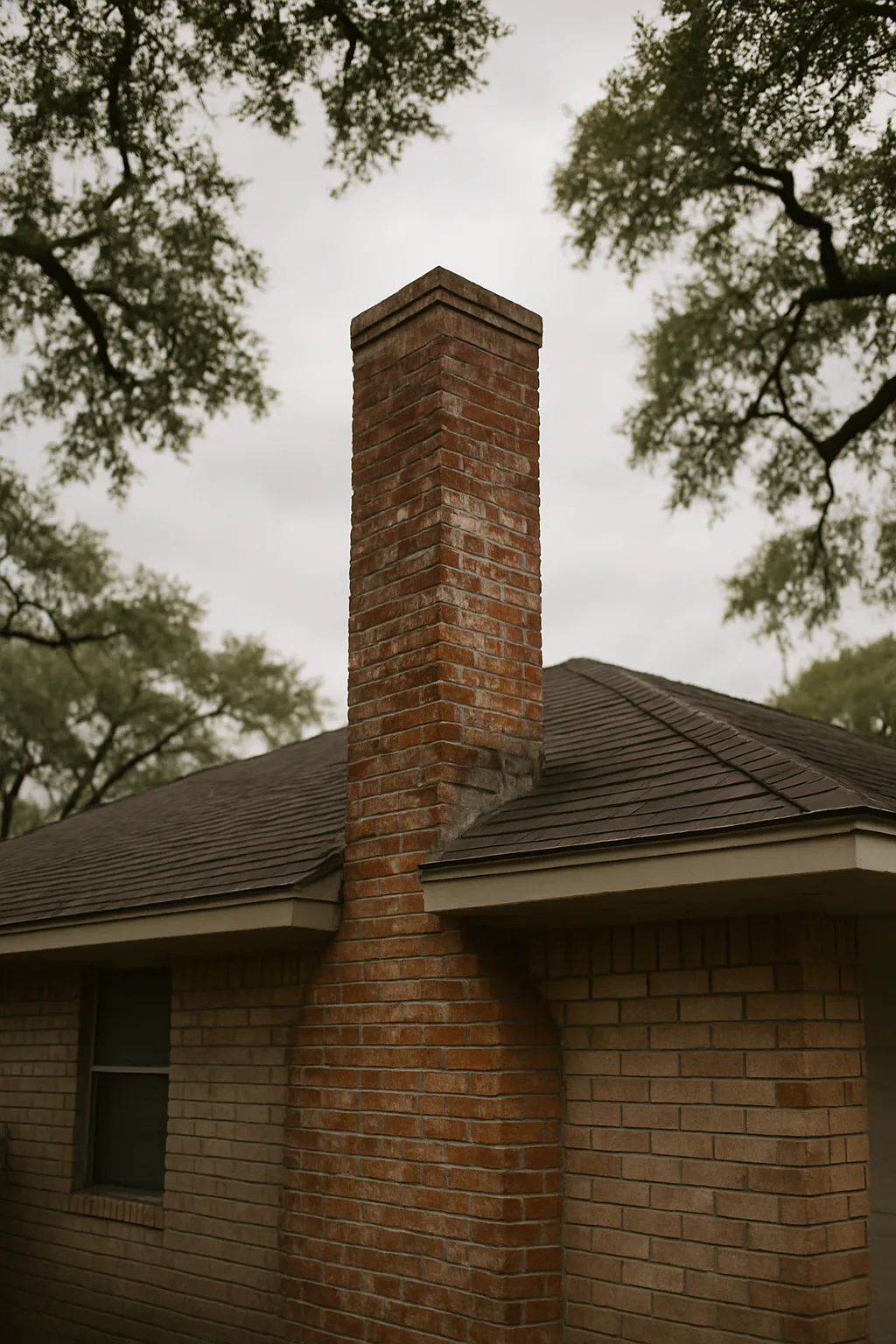
Smoke rolling back into your living room. A fire that won't draw. Carbon monoxide building up quietly behind the wall. Draft failures are not quirks to live with. They are diagnosable, fixable problems, and most Houston homeowners don't know where to start.
Free quote available. Serving Greater Houston. Licensed & insured. In business since 2020.
Learn more about chimney animal removal Houston in The Woodlands, TX →
Learn more about chimney leak repair Houston in Sugar Land, TX →
Draft is the upward movement of combustion gases through your flue. It works on a simple physics principle: hot gas is lighter than cool air, so it rises. When your fire burns, heated gas climbs the flue and exits at the top. Cooler outdoor air replaces it at the firebox. That exchange is draft.
The problem is that a dozen variables can disrupt that exchange. Flue height, liner condition, cap design, outside temperature, house pressure, and even how airtight your home is all affect whether your chimney draws correctly.
In Houston, the climate stacks the odds against you. Gulf humidity causes efflorescence, liner spalling, and mortar deterioration that narrow the flue and disrupt airflow. A chimney that drew fine five years ago may be struggling today without any visible warning sign indoors.
Any of these symptoms warrants a camera inspection before the next fire. The EPA and the NFPA both document carbon monoxide fatalities linked to blocked or improperly functioning flues. Standard residential CO detectors respond slowly to gradual buildup, so don't rely on an alarm to catch every scenario.
Modern Houston homes are built tighter than homes from the 1980s. Range hoods, bath fans, and whole-house exhausts create negative pressure that overpowers chimney draft. The flue becomes a fresh-air intake instead of an exhaust. This is increasingly common in homes remodeled after Hurricane Harvey.
NFPA 211 requires a flue to extend at least 2 feet above any structure within 10 feet. Trees that have grown up around a Houston home, roofline additions, and missing or poorly designed caps all create downdraft. A replacement chimney cap sized to your flue often resolves recurring downdraft without major work.
Cracked terracotta liners, bird nests, and creosote accumulation all reduce effective flue area. A flue that's 20% blocked can cut draft by more than half. Camera inspection locates the restriction precisely, so repairs target the actual problem instead of guesswork.
Every diagnostic call starts the same way: camera first, conclusions second. We don't quote repairs before we know what we're looking at.
We run a high-definition camera through your flue from firebox to crown. You see everything we see, in real time, on a monitor at the job site. After the visit, you receive a written report with photos that document liner condition, blockages, damper function, and clearance issues.
That report is yours permanently. It's useful for insurance claims, home sales, and HOA documentation. Learn more about our forensic chimney draft analysis and standard draft analysis services.
If the camera shows a structurally clean flue but you still have draft problems, the issue is often pressure-related. We measure house pressure relative to outside air and identify which mechanical exhausts are pulling air backward through the flue.
Solutions may be as simple as cracking a window while the fireplace is in use, or as involved as installing a makeup air supply near the firebox. We explain every option and let you decide what fits your home and budget.
Level 1 covers accessible portions of the chimney and is appropriate for systems that have been in normal use without changes. Level 2 includes camera inspection of internal flue surfaces and is required whenever you change fuel type, add or replace an appliance, or sell the home. Level 3 involves removal of structure to access hidden areas, typically after a chimney fire or major storm.
Most draft complaints we see require at minimum a Level 2. Our preventive inspection service covers this fully.
If your liner is cracked, undersized for a new appliance, or missing entirely, relining typically resolves the draft problem permanently. We install stainless steel flexible liner sized to the NFPA 211 requirements for your specific appliance and fuel type.
Liner installation on a single-story Houston home typically takes one day. Learn about chimney relining and liner installation in detail.
Active carbon monoxide alarms, post-storm damage, and flue fires cannot wait until Monday. We respond around the clock. Emergency chimney services available now.
Licensed and insured, serving Greater Houston including Pasadena, Sugar Land, Pearland, The Woodlands, Katy, and surrounding communities.
Houston's average relative humidity runs above 75% for most of the year. Water infiltrating a clay tile liner through freeze-thaw cycles, even the mild ones Houston sees, causes spalling that deposits debris in the flue and reduces draft area. Our guide to Houston's climate and chimney damage covers this in depth. Chimney waterproofing is often the first line of defense.
Tropical storms push debris, leaves, and animals into uncapped flues. After any significant storm, assume your flue may be partially blocked before you use it. See our tropical storm season chimney preparation guide and our emergency storm damage repair service.
White staining on brick exterior is efflorescence, a sign that water is moving through the masonry and depositing minerals on the surface. It's a diagnostic signal, not a cosmetic problem. Left alone, it accelerates spalling that can close off flue area. We offer efflorescence chimney repair in Pasadena and Houston.
Draft problems discovered during a home sale negotiation cost more than draft problems found during a routine inspection. A Level 2 inspection before listing gives sellers time to repair and document, rather than negotiate under pressure at closing.
Buyers should request chimney inspection as a standard condition, separate from the general home inspection. General inspectors are not trained to evaluate flue interiors. Our written report and photos give buyers and their agents concrete documentation. See our full guide on chimney inspections and Houston home sales.
HOAs managing communities with shared or multiple chimneys can schedule annual maintenance plans or our dedicated HOA chimney maintenance program.
These are the questions we hear most often from Houston homeowners who are dealing with chimney draft issues for the first time.
Yes. Gas appliances still produce combustion byproducts that must vent through the flue. If you're smelling exhaust gases indoors, either the flue is blocked, there's a negative-pressure condition pulling exhaust back in, or the appliance is misaligned with its vent connector. All three are diagnosable. Do not continue using a gas appliance that smells like combustion gases indoors until a technician has inspected it.
A standard Level 2 inspection with camera run and pressure assessment takes 2 to 4 hours on a typical Houston home. You receive a verbal summary before the technician leaves and a written report with photos within 24 hours. If additional testing is needed, we schedule that on a separate visit so we're not estimating under time pressure.
Hotter fires do improve draft temporarily by increasing the temperature differential in the flue. But they don't fix the underlying cause, and they accelerate creosote hardening if the flue walls are cool enough to condense exhaust. If you have to burn hot just to prevent smoking, that's a sign the flue system is undersized, partially blocked, or has a pressure issue that needs to be addressed properly. See our chimney sweep vs DIY guide for more context.
More than most homeowners expect. The combination of high humidity, frequent rain, and occasional hard freezes is particularly damaging to masonry and clay liner systems. A chimney in Houston typically shows moisture-related deterioration faster than the same chimney in a dry climate. Annual inspections catch early signs before they turn into draft failures or structural repairs. See how Houston's climate destroys chimneys and what to ask before booking a chimney company.
Costs vary with chimney height, liner diameter, and condition of the existing liner. We provide exact quotes after inspection because the camera often reveals conditions that change the scope. What we can say is that relining a single-story Houston chimney for a wood or gas appliance is a one-day job in most cases. Detailed pricing context is in our Houston chimney cleaning and service cost guide.
Yes, in two ways. First, a leaking or open chimney system lets humid outdoor air in, which can cause musty odors and condensation inside the firebox. Second, gas appliance flues and furnace exhaust systems operate year-round. A summer blockage from nesting birds or a collapsed liner section is just as urgent as a winter one, because CO risk doesn't take a seasonal break.
If your flue isn't working right, call us before you light another fire. We serve Greater Houston, including Pasadena, Sugar Land, Pearland, The Woodlands, Katy, and surrounding areas. Licensed and insured. Free quotes. Available 24/7 for emergencies.
The CDC estimates carbon monoxide poisoning sends tens of thousands of Americans to emergency rooms each year. A functioning chimney is not optional.
© 2026 Novak Chimney Masters. Houston, TX. Licensed & Insured.
Tell us what the chimney is doing and a Novak technician will map out the next step.